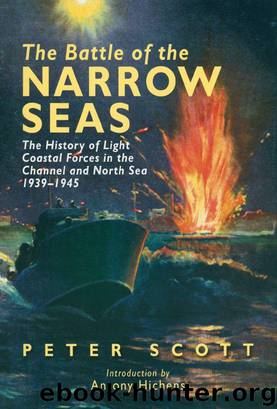
The Battle of the Narrow Seas: The History of Light Coastal Forces in the Channel and North Sea 1939-1945 by Scott Peter
Author:Scott, Peter [Scott, Peter]
Language: eng
Format: azw3
Publisher: Seaforth Publishing
Published: 2009-09-23T16:00:00+00:00
SHIPS THAT PASS IN THE NIGHT
Not so successful, but no less exciting, was an adventure of Dickens’a few nights later, on the 15th November, 1942. His force was again two M.T.Bs.—one, commanded by Lt. Felce, in which he was embarked, and the other by Lt. Perkins. The two boats were lying in wait for a convoy off the coast of Holland, on a dark night with a fairly strong north-west wind. The visibility was very poor and it was drizzling.
Soon after a quarter to two in the morning, Dickens sighted two ships on his starboard quarter coming towards him:
“I shouted to the other boat, but she could not hear owing to the wind; it appears, however, that she sighted at much the same time as I did. My first impression was that the enemy were trawlers, and I decided to attack. I therefore carried on on a northerly course so as to increase my distance from the line of advance of the enemy. Very shortly after this I observed that the range had decreased considerably, and this showed that the targets were moving fast. Then I saw that they were destroyers. They were steering to pass about 100 yards astern of me, and I tried to decide whether I had been sighted and they were preparing to ram, in which case I had better disengage, or whether I was still unobserved. As they were not coming straight at me I chose the latter alternative, put the wheel over to port and hoped I could turn in time to get the sights on before it was too late.”
By this time the. leading destroyer was right on top of the second M.T.B. “He passed close astern of us,” says Lt. Perkins, “at a range of about 40 yards, alarm bells and shouting being heard. Then I saw another destroyer about half a cable astern. As I was facing in completely the wrong direction, I knew I would have no time to turn before they were both past, and I thought there was considerable chance of being rammed by the second destroyer.” So Perkins made a crash start and moved out to gain a suitable attacking position.
Meanwhile Dickens’ boat had turned to port and was in a good position to fire torpedoes at the incredibly short range of 150 yards. There was no time to set the torpedo sight, and the torpedoes had to be fired by eye.
“I was too concerned,” Dickens’ report goes on, “with the danger of missing astern, having judged the enemy’s speed to be 25 knots, and gave the order too early. Both torpedoes ran straight and were seen to pass very close ahead. I was too close to the enemy to disengage in the normal manner and therefore started main engines and passed through their line. The second ship altered course to port as I came through; perhaps she thought I was a torpedo. It was only when I was about 200 yards away that the enemy started firing, but even then it was wild.
Download
This site does not store any files on its server. We only index and link to content provided by other sites. Please contact the content providers to delete copyright contents if any and email us, we'll remove relevant links or contents immediately.
The Vikings: Conquering England, France, and Ireland by Wernick Robert(84606)
Ali Pasha, Lion of Ioannina by Eugenia Russell & Eugenia Russell(40386)
The Conquerors (The Winning of America Series Book 3) by Eckert Allan W(39187)
The Vikings: Discoverers of a New World by Wernick Robert(37051)
Cecilia; Or, Memoirs of an Heiress — Volume 1 by Fanny Burney(32726)
Cecilia; Or, Memoirs of an Heiress — Volume 2 by Fanny Burney(32090)
Cecilia; Or, Memoirs of an Heiress — Volume 3 by Fanny Burney(32068)
Empire of the Sikhs by Patwant Singh(23208)
The Secret History by Donna Tartt(19477)
Hans Sturm: A Soldier's Odyssey on the Eastern Front by Gordon Williamson(18727)
Cat's cradle by Kurt Vonnegut(15565)
Pimp by Iceberg Slim(14805)
Sapiens: A Brief History of Humankind by Yuval Noah Harari(14558)
Norse Mythology by Gaiman Neil(13576)
Talking to Strangers by Malcolm Gladwell(13559)
Leonardo da Vinci by Walter Isaacson(13528)
4 3 2 1: A Novel by Paul Auster(12628)
Underground: A Human History of the Worlds Beneath Our Feet by Will Hunt(12237)
The Radium Girls by Kate Moore(12192)
